A browned crust can look convincing while the center remains dangerously undercooked. That is why you should use a meat thermometer, especially when preparing poultry, burgers, roasts, or thick steaks. USDA’s Food Safety and Inspection Service states that color and texture are unreliable indicators of doneness. Only a food thermometer can verify whether meat has reached a safe internal temperature.
The risk is not theoretical. The Centers for Disease Control and Prevention estimates that foodborne illnesses cause about 48 million illnesses, 128,000 hospitalizations, and 3,000 deaths in the United States each year. These figures cover many foods, but they show why small kitchen decisions matter. The FDA Food Code also provides science-based cooking standards for controlling harmful bacteria. For example, poultry should reach 165°F (74°C), while ground meats generally require 160°F (71°C), according to USDA guidance.
Temperature is evidence.
A reliable thermometer also improves cooking quality. Insert the probe into the thickest part, avoiding bone, gristle, or the pan. Wait for the reading to stabilize. I have seen cooks trust a browned surface, then discover a pink, cool center after slicing. That mistake is easy to make, even with experience. Thermometers can also be misused, placed too shallowly, or left uncalibrated. This deserves honest attention. A dependable tool only helps when used correctly, cleaned between foods, and checked regularly. In the following discussion, practical temperature targets, placement techniques, and common mistakes will explain how a small reading can protect both dinner and the people sharing it.
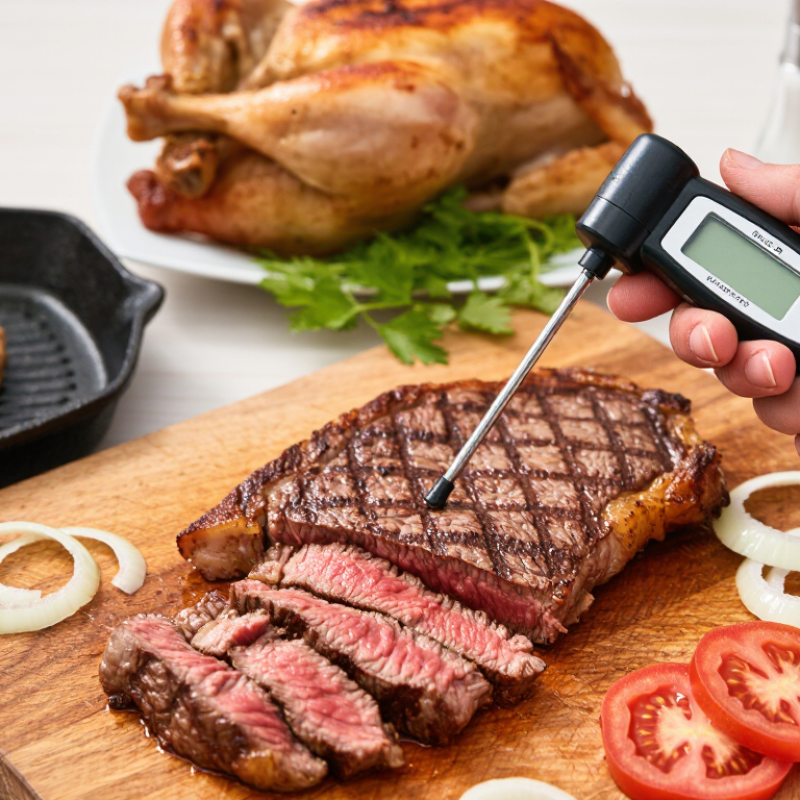
A meat thermometer measures the temperature inside food, usually at the probe’s sensing tip. It does not measure color, texture, or cooking time. Those clues can mislead you. A browned crust may hide a cool center, while a pale surface may contain fully cooked meat. When I cook thick chicken breasts, I insert the probe through the side into the thickest area. This helps me find the coldest likely spot, not the warmer edge. Keep the tip away from bone, fat, and the pan. They can distort the reading.
The number shows how much heat has reached the center at that moment. It can also reveal uneven cooking. A roast may read 68°C near one end and 61°C near the middle. That difference matters. Meat can continue cooking after removal because retained heat moves inward. I once removed a roast too early, trusting its color, and the center remained cooler than expected. The thermometer exposed my mistake. I now check more than one location when the cut is large or irregular.
For reliable decisions, use temperatures validated by public food-safety authorities for the specific meat and preparation. Poultry, ground meat, and whole cuts do not behave identically. Clean the probe before and after use, and check its accuracy if readings seem strange. An ice-water check can reveal a calibration problem, although my own checks are not always perfect. Read the display at eye level and wait for the number to stabilize. Small habits matter.
A meat thermometer is more than a cooking gadget. It measures the temperature that determines whether harmful bacteria have been reduced safely. Color and texture can mislead you, especially with thick steaks, roasted poultry, and ground meat. The USDA Food Safety and Inspection Service states that a thermometer is the only reliable way to confirm doneness. Its guidance recommends 165°F for poultry, 160°F for ground meats, and 145°F for whole cuts of beef, pork, lamb, and veal, followed by a three-minute rest.
The CDC estimates that foodborne illnesses cause about 48 million illnesses, 128,000 hospitalizations, and 3,000 deaths in the United States each year. These figures come from its major burden estimates, not from every kitchen mistake being reported. Still, they show why internal temperature matters. Insert the probe into the thickest section, avoiding bone and the pan. Check more than one spot. A small error can change the result.
Tips: Clean the probe before and after use. Calibrate it occasionally with ice water. Do not rely on appearance alone. Rest meat as recommended, then measure again if the center seems uncertain. I sometimes rush this step, and that is exactly the habit worth questioning. Thermometers can also read incorrectly when inserted too shallowly or touched against hot cookware.
A meat thermometer turns guesswork into measurable control. The USDA Food Safety and Inspection Service recommends 165°F (74°C) for poultry, 160°F (71°C) for ground meat, and 145°F (63°C) for whole cuts of beef, pork, lamb, and veal, followed by a rest. Color can mislead you. Juices can look clear before the center reaches a safe temperature.
Choosing the right meat thermometer starts with your cooking habits. An instant-read model works well for steaks, chicken breasts, and burgers. For roasts, a leave-in probe lets you monitor the center without repeatedly opening the oven. Look for a clear display, a narrow sensing tip, a wide temperature range, and simple cleaning. Accuracy matters. The USDA advises checking calibration with an ice-water test, which should read 32°F (0°C). I once trusted a slow thermometer and overcooked a roast because I checked the edge, not the center.
Placement matters too. Insert the probe into the thickest section, avoiding bone, fat, and the pan. Take readings from more than one spot when the meat is uneven. The CDC estimates that foodborne illnesses affect about 48 million people in the United States each year, causing roughly 128,000 hospitalizations and 3,000 deaths. Those figures make a small measuring tool feel less optional. Still, no thermometer replaces clean hands, separate utensils, and careful storage. I sometimes rush cleanup after cooking. That is a habit worth correcting.
Why You Should Use a Meat Thermometer Every Time?
Where and how you insert the thermometer matters as much as the reading itself. Place the probe in the thickest part of the meat, where cooking takes longest. Keep the tip away from bone, gristle, and large pockets of fat. These areas can distort the temperature. For a whole chicken, insert the probe into the inner thigh without touching the bone. Check the thickest breast area too. Different parts may cook at different speeds.
For steaks, roasts, and pork chops, insert the thermometer from the side until the tip reaches the center. This works better than checking from above, especially with thinner cuts. Ground meat needs a reading from the middle, not just the browned surface. Move the probe to two or three spots. One reading can mislead you.
I used to test meat near the edge because it was easier. That habit was wrong. The center was still cooler. Clean the probe before and after each use, and wait for the display to stabilize. Food safety guidance commonly recommends 74°C for poultry and 71°C for ground meats. Whole cuts of beef or pork may be safe at lower temperatures when properly rested, but personal preference still matters. A thermometer cannot replace judgment. It can expose it.
I used to judge doneness by color, but a browned surface can hide an undercooked center. A meat thermometer removes much of that guesswork, especially when cuts vary in thickness. Insert the probe into the thickest section, avoiding bones, fat pockets, and the cooking pan. For poultry, look for 165°F (74°C). Ground meat should reach 160°F (71°C). Whole cuts of beef, pork, lamb, and veal generally need 145°F (63°C), followed by three minutes of rest. Fish is also commonly checked at 145°F (63°C). These targets reflect widely used food-safety guidance, not personal preference.
Different meats need different checking habits. A thick chicken breast may read safe near the surface but remain cooler beside the bone. A burger can look brown before its center reaches a safe temperature. For steak or roast, test the middle from the side when possible. For fish, place the probe in the thickest part, where the flesh flakes last. I check twice: once near the expected finish, then again after resting. Heat can continue moving inward, raising the temperature several degrees. My readings are not always perfect. The probe may touch a bone, or I may test the wrong spot. When accuracy matters, I test it in ice water before cooking. I also wipe the probe between foods and investigate any unusual reading.
Checking doneness across different types of meat is more reliable with an instant-read thermometer than by color or cooking time alone.
Recommended minimum internal temperatures: whole cuts of beef, pork, lamb, and veal should reach 145°F (63°C) with a 3-minute rest; ground meats should reach 160°F (71°C); poultry should reach 165°F (74°C); and fish should reach 145°F (63°C). Measure the thickest part without touching bone.
It checks internal heat, where harmful bacteria may remain. Color and browning can mislead you. This matters.
Poultry should reach 165°F (74°C). Check the thickest area, especially near the bone.
Ground meat should reach 160°F (71°C). A brown burger can still have a cooler center.
Whole cuts of beef, pork, lamb, and veal generally need 145°F (63°C). Rest them for three minutes.
Insert it into the thickest section. Avoid bones, fat pockets, cookware, and the pan.
Yes. Test several areas, especially with thick chicken breasts or uneven roasts. A small error can change the result.
No. A browned surface may hide an undercooked center. Use temperature, not color alone.
Test it in ice water occasionally. Clean the probe before and after use. I sometimes rush this step.
Check again if the center seems uncertain. Heat may continue moving inward and raise the temperature slightly.
Fish is commonly checked at 145°F (63°C). Insert the probe into the thickest flesh, where it flakes last.
A meat thermometer is an essential kitchen tool because it measures the internal temperature of food, not just the color or texture of its surface. Understanding why you should use a meat thermometer helps ensure that meat reaches a safe temperature while avoiding unnecessary overcooking. Since different meats and cuts vary in thickness, shape, and cooking time, relying only on appearance can lead to inaccurate results. An accurate thermometer provides a dependable way to check both safety and doneness.
Choosing the right thermometer depends on your cooking habits, but it should be easy to read, reliable, and suitable for the type of cooking you do. Insert the probe into the thickest part of the meat, avoiding bones, fat, and the pan, then wait for a stable reading. Check large roasts, poultry, ground meat, and thinner cuts carefully, as each may require a different approach. By checking temperature throughout the cooking process, you can serve meat that is safer, juicier, and cooked to your preferred level.

Fergus Kitchen